

Durham Light Infantry: History, Service and Remembrance in Durham Cathedral

The Durham Light Infantry holds a unique place in British military history — not just for its service on the battlefield, but for the deep connection it maintains with the people and communities of the North East.
For many families across County Durham, the DLI is not just a regiment. It’s part of their story.
And nowhere is that more clearly remembered than inside Durham Cathedral, where the regiment’s legacy has been preserved with quiet dignity.
A Regiment Forged in Service
First established as the 68th Regiment of Foot in 1758, the Durham Light Infantry was formally created in 1881.
The regiment first saw action in Egypt and later in South Africa during the Boer War, before going on to serve in both the First and Second World Wars — fighting in every major theatre of conflict.
The scale of sacrifice was immense.More than 12,600 soldiers of the DLI lost their lives in the First World War alone, with thousands more wounded. Across County Durham, there were very few families untouched by that loss.
The regiment remained in service until 1968, when it was amalgamated with other light infantry regiments to form The Light Infantry.
On 12 December 1968, the regiment paraded its colours inside Durham Cathedral for the final time.
Why the DLI Chapel Exists
In the aftermath of the First World War, memorials were being created across the country to honour those who had fallen.
Given the heavy losses suffered by the Durham Light Infantry, it was decided that a permanent place of remembrance should be created at the heart of the county.
In 1922, the regiment’s officers and the Cathedral Chapter agreed to establish a memorial chapel within Durham Cathedral, converting two former pre-Reformation chapels.
Designed by architect W.D. Caroe, the chapel was funded through the regiment, the Dean and Chapter, public subscription, and the Prisoners of War Parcels Fund.
It was dedicated on 20 October 1923 by the Bishop of Durham, Hensley Henson.
The DLI Chapel Today
Today, the chapel remains one of the most important regimental memorial spaces in the country.
Within it, you will find:
The regimental battle colours, laid up in the Cathedral after the regiment’s final parade in 1968
Memorial crosses and regimental artefacts
A space designed not for spectacle, but for reflection
Among the most poignant items is a battlefield cross from the Butte de Warlencourt, connected to the Battle of the Somme in November 1916.
Following the battle, three wooden crosses were erected on a chalk hill at Warlencourt in memory of soldiers from the 6th, 8th and 9th Battalions of the Durham Light Infantry who were killed there. One of these crosses is now housed within the DLI Chapel, while the others are held in parish churches at Bishop Auckland and Chester-le-Street.
As part of First World War commemorations, the three crosses have at times been brought together again — a powerful and deeply moving reminder of the men they were raised to honour.
Alongside these historic elements, the chapel has also hosted temporary installations, including silhouette displays representing fallen soldiers and nurses. These subtle additions provide a modern visual reflection of loss, complementing the chapel’s enduring sense of remembrance.
The Book of Remembrance
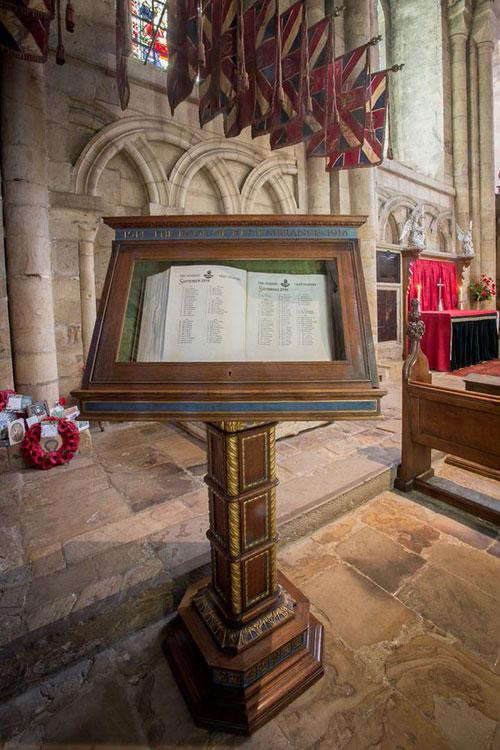
At the heart of the chapel sit the Books of Remembrance, among the most powerful memorials connected to the Durham Light Infantry.
The First World War book records over 12,600 names
The Second World War volume includes more than 3,000 names
A Small Campaigns Book records those lost in Korea, Borneo, Cyprus, and Northern Ireland between 1952 and 1973
Each name is carefully recorded, and the pages are turned daily.
The books are arranged by date of death, meaning that each day reflects those who fell on that same date — year after year.
In the First World War volume especially, the repetition of surnames tells its own story.Neighbours, friends, and relatives enlisted together, forming what became known as Pals battalions.
This is not just remembrance.It is a living record of a community at war.
A Living Memorial
The Books of Remembrance are not fixed in time.
As new research uncovers missing names, they continue to be updated — ensuring that those previously overlooked are properly recognised.
Visitors can request to view specific entries with assistance from the Cathedral vergers, making the experience deeply personal.
Why the DLI Still Matters Today
Although the regiment formally ended in 1968, its legacy has never disappeared.
It lives on through:
Family histories across the North East
The DLI Chapel and its memorials
The enduring identity of County Durham
For many, the Durham Light Infantry represents more than military service.It represents shared experience, sacrifice, and belonging.
A Meaningful Way to Remember
Remembrance does not belong to one day alone.
For those with a connection to the Durham Light Infantry — whether through service, family, or heritage — having a physical reminder at home can carry that connection forward.
A memorial piece, placed quietly on a shelf or mantel, serves the same purpose as the chapel in its own way:
Not loud. Not overstated. Just remembered.
In Summary
The Durham Light Infantry is more than a regiment — it is part of the identity of County Durham.
From its origins in 1758 to its final parade in Durham Cathedral, its story is one of service, sacrifice, and community.
Within the DLI Chapel — through the battle colours, the Books of Remembrance, the Butte de Warlencourt cross, and the quiet presence of modern installations — that story continues to stand to attention.
And through remembrance, it continues to be honoured properly.


Comments